




Load Testing of Hydraulic Power Steering Racks: Equipment and Practical Value
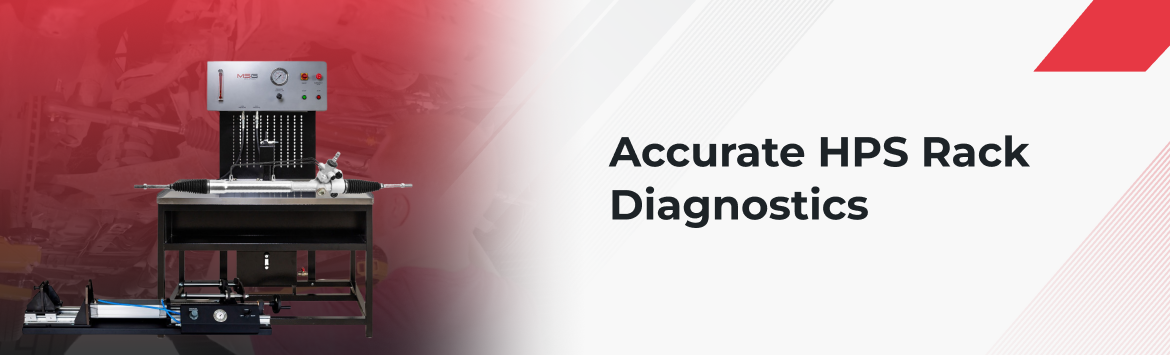
Vehicles equipped with hydraulic power steering (HPS) are still commonly found on the road. Despite the seemingly simple design of hydraulic power steering systems, these units often become a source of customer complaints after repair. The main reason for such issues is the use of diagnostic equipment that tests the steering rack only in a “no-load” mode, i.e., without resistance to rack movement. Under such conditions, some defects of HPS steering racks do not manifest themselves.
During free movement, the rack may appear serviceable, but after installation on the vehicle, the following problems may occur:
- knocking noises during parking maneuvers;
- uneven steering effort;
- customer complaints about a “stiff” or “loose” steering feel.
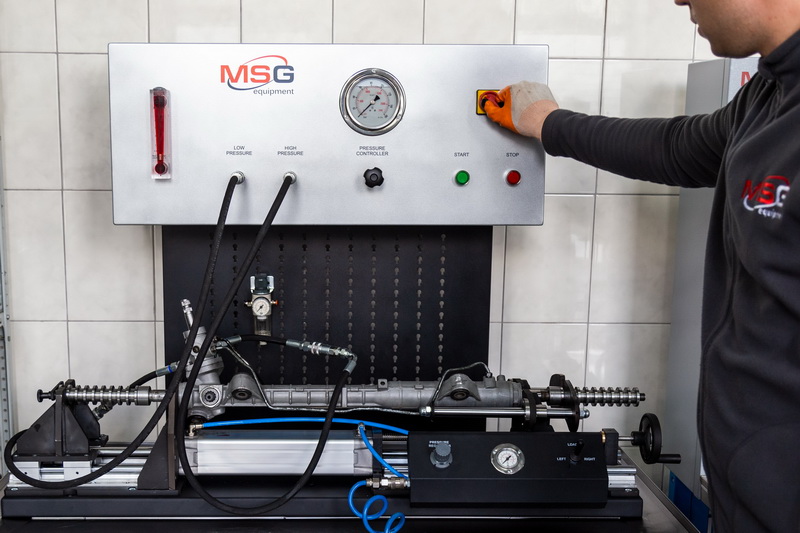
Load testing of hydraulic power steering racks allows the unit to be evaluated under conditions that closely replicate real vehicle operation, ensuring predictable and high-quality repair results. This capability is provided by the combined use of the MS502M test bench and the MS521 loading mechanism.
Technical Basis of Load Diagnostics
A hydraulic power steering rack consists of a rack-and-pinion mechanism, a control valve (spool valve) assembly, a hydraulic cylinder, bushings, and bearings. When the steering wheel is turned, force is transmitted not only mechanically but also through hydraulic pressure. Defects become apparent precisely under pressure conditions.
Testing in a “no-load” mode allows the required pressure to be generated only at the extreme rack positions, which makes diagnostics incomplete. Creating resistance to the movement of the rack-and-pinion mechanism generates the necessary pressure throughout the entire stroke of the rack. This makes it possible to identify defects that cannot be detected when the rack moves freely. Such defects include internal leakage in the control valve, the condition of the central seal of the hydraulic cylinder, and wear of the cylinder housing in its central section.
MS502M Test Bench — Full Control of the Hydraulic Section
The MS502M is the central element in the diagnostics of hydraulic power steering racks. All measurements are performed and operating parameters are analyzed on this test bench.
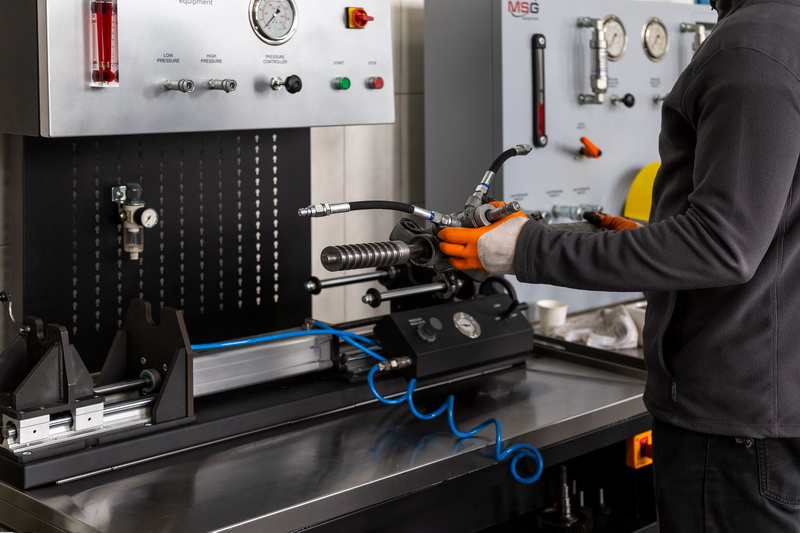
The MS502M provides:
- supply and regulation of hydraulic pressure;
- pressure monitoring in working channels;
- testing of control valve operation;
- detection of internal and external leaks;
- analysis of parameter stability in various operating modes.
It forms an objective picture of the condition of the hydraulic section of the steering rack and allows most faults to be identified even without additional devices. However, when combined with the MS521 mechanism, it creates a complete test environment in which the steering rack is evaluated as a single functional unit.
MS521 Mechanism — Mechanical Load Control
The MS521 testing mechanism is designed to create adjustable resistance to steering rack movement. It simulates the forces that occur when the vehicle wheels are turned, allowing an objective assessment of the mechanical condition of the unit.
The MS521 provides stable and repeatable load across the entire rack stroke, which is particularly important when checking effort uniformity and identifying localized defects. The ability to operate in dynamic modes makes it possible to evaluate rack behavior during rapid direction changes and under maximum resistance—conditions typical of parking maneuvers.

Practical Value for the Workshop and the Customer
- More accurate diagnostics before installing the rack on the vehicle.
- Significant reduction in returns and warranty claims.
- Repair quality control based on objective measurements.
- Increased customer trust and improved workshop reputation.
For the business, this means consistent results and predictable quality; for the customer, it ensures confidence in the safety and proper operation of the steering system.
Conclusion
Load testing of hydraulic power steering racks represents an optimal combination of engineering accuracy and practical benefit. Using the MS521 mechanism together with the MS502M test bench allows the unit to be tested under conditions that closely replicate real-world operation, reveals defects that cannot be detected by conventional testing, and guarantees stable repair results.
This approach transforms diagnostics from a formal procedure into an effective tool for quality control and service development.