





Features of Using Testers and Test Benches in Alternator Diagnostics

Modern alternators have long ceased to be “simple” electrical machines. Their design includes electronic voltage regulators, control systems using LIN and COM protocols, Start-Stop systems, and complex operating algorithms controlled by the engine control unit (ECU). Under such conditions, accurate diagnostics is impossible without professional equipment.
In practice, two main types of devices are used: testers and diagnostic test benches. They serve different purposes, and understanding their roles not only improves repair quality but also significantly increases the efficiency of a service station.
This article uses the MS016A tester and the MS005A test bench as examples to clearly demonstrate the differences and complementary nature of these types of equipment.
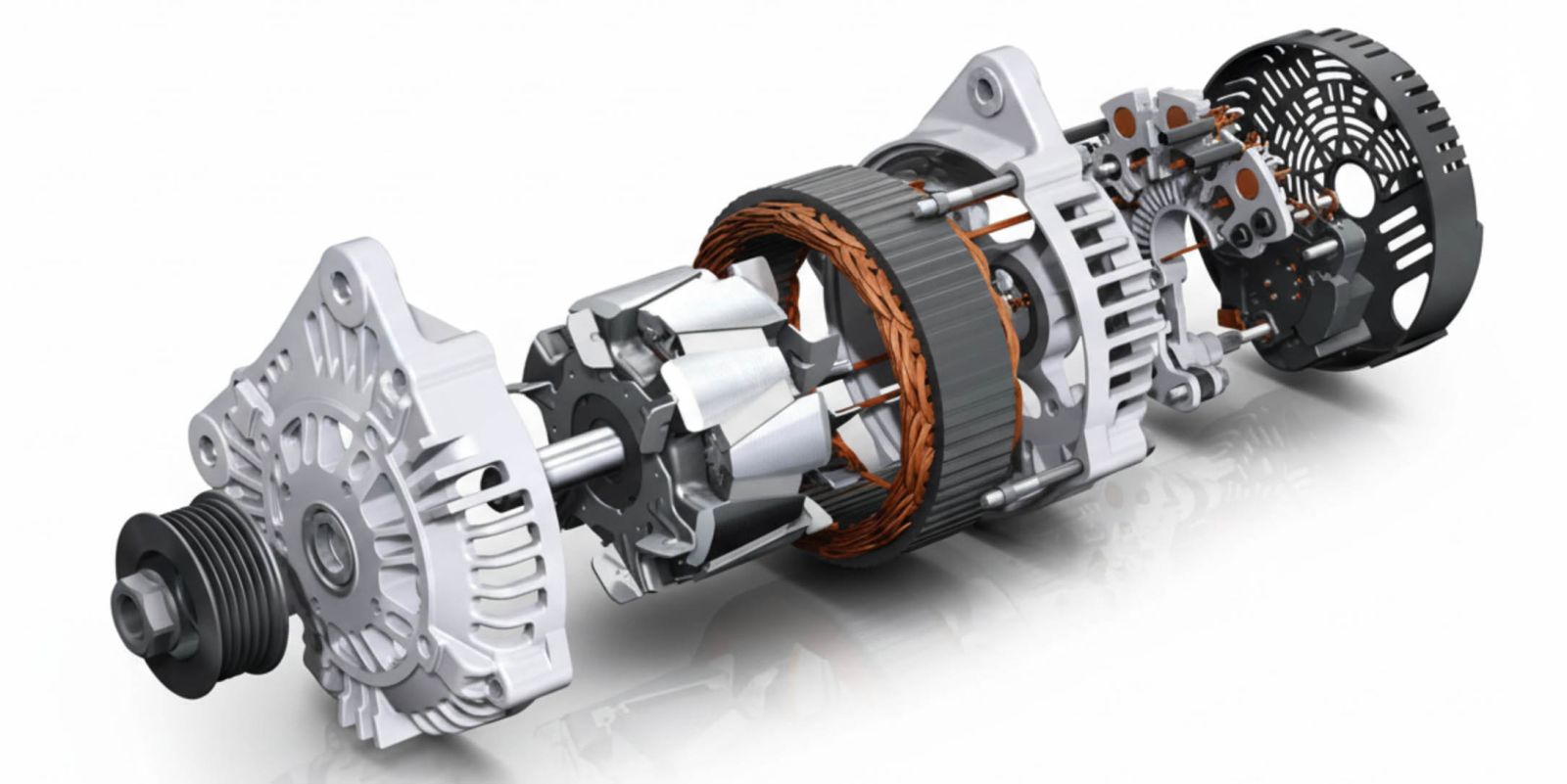
Tester as an On-Vehicle Diagnostic Tool
A tester is primarily a tool for fault detection and assessing the condition of an alternator directly on the vehicle. It allows diagnostics without removing the unit, which is critically important at the initial stage. With a tester, it is possible not only to measure voltage but also to analyze how the charging system operates. Its main purpose is to determine whether the problem lies within the alternator or outside it. This is especially important for modern vehicles with controlled alternators.

Using the MS016A, it is possible to:
- check alternator operation without removing it from the vehicle;
- assess the correctness of the voltage regulator operation;
- connect to the alternator control system and verify whether commands from the ECU are present.
If the alternator does not produce charging output, the tester helps quickly determine whether the alternator itself is faulty or if control from the vehicle is missing. This helps avoid a common mistake — replacing a fully functional alternator.
In essence, the tester is a tool that helps the technician make the correct decision regarding further repair actions.
Test Bench as a Tool for Advanced Diagnostics
If the tester answers the question “where is the problem?”, the test bench answers “what exactly is causing the alternator failure?” After removing the unit, the MS005A diagnostic test bench allows a complete inspection under controlled conditions.
It enables:
- driving the alternator at a specified speed;
- controlling alternators with both conventional and smart voltage regulators via LIN and CAN;
- working with Start-Stop systems, including 12V and 48V alternators;
- applying an adjustable electrical load;
- measuring key operating parameters.
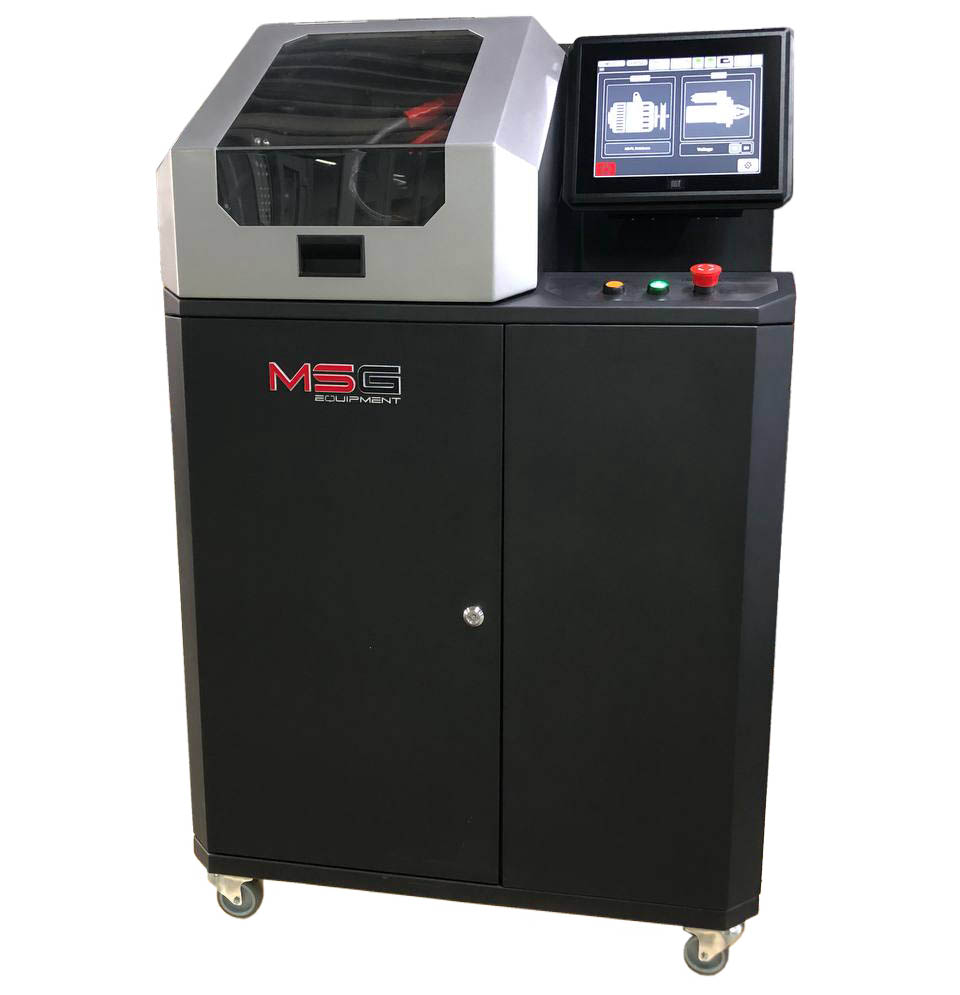
Parameters Analyzed on the MS005A Test Bench:
- Stabilized voltage — used to evaluate the correctness of the voltage regulator operation;
- Output current — reflects the actual performance of the alternator and helps identify issues in windings or diodes;
- Voltage ripple — helps detect faults in the rectifier (diode bridge);
- Operation at different speeds — allows evaluation of generation stability;
- Behavior under load — reveals hidden defects that do not appear in other modes, such as inter-turn short circuits in the stator, winding degradation, or partial diode breakdown;
- Real-time thermal analysis — makes it possible to “see” defects that are not yet clearly visible in voltage or current. This includes inter-turn short circuits, diode bridge faults, poor electrical contacts, and increased internal losses.
Thus, unlike a tester, a test bench provides a complete picture of the alternator’s performance. Most importantly, it allows detection of hidden defects that cannot be identified on the vehicle.
How the Tester and Test Bench Work Together
These two types of equipment do not compete — they form a unified diagnostic system.
In practice, the process looks like this:
- the MS016A tester is used on the vehicle to assess system condition and locate the source of the problem;
- after removal, the MS005A test bench is used to determine the exact cause of the failure;
- after repair, the test bench is used again to confirm proper operation.
This approach ensures maximum diagnostic accuracy and eliminates “blind” repairs.
Economic and Practical Benefits of Using Equipment
The use of professional equipment is not only about technical accuracy but also about service efficiency.
Key benefits include:
- reduced diagnostic time — more vehicles serviced;
- fewer errors — fewer returns;
- increased customer trust — ability to justify diagnostic results;
- expanded service capabilities — support for modern alternators and control systems;
- improved staff qualification — standardized diagnostic processes.
In addition, having both a tester and a test bench allows building a transparent and repeatable repair process.