





EV Battery Recovery: Can Lost Capacity Be Restored?
The high-voltage battery is one of the most expensive components of an electric vehicle, so a decline in its performance is naturally a cause for concern for the owner. One of the most common questions asked by EV owners and service technicians is:
«Can the battery capacity be restored by fully charging and discharging it several times in a row?»
This question has not arisen by chance. Many people remember that several full charge and discharge cycles could indeed improve the performance of nickel-cadmium batteries due to the so-called memory effect. However, modern EV traction batteries predominantly use lithium-ion cells, which do not have the classic memory effect. Does this mean that several full cycles can never improve the condition of a battery? To answer this question, let us first look at why a battery loses capacity.
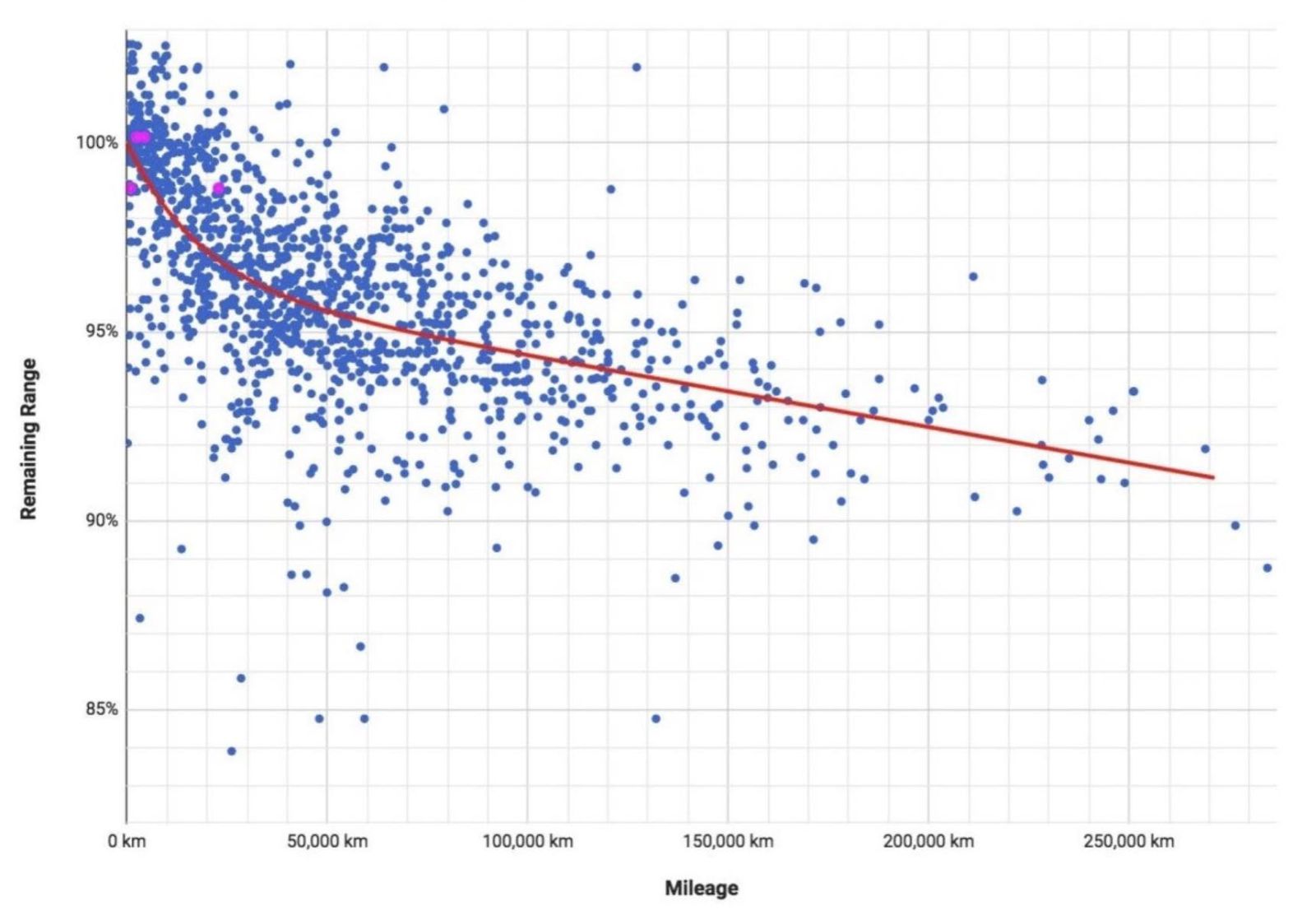 Relationship between remaining battery capacity and mileage of Tesla Model S/X vehicles.
The graph clearly shows how significant the variation in battery degradation can be even at relatively low mileage.
Why does battery capacity and driving range decrease?
A reduction in driving range does not always mean that the high-voltage battery has actually lost the same amount of capacity. The amount of available energy depends both on the condition of the battery cells and on the vehicle's operating conditions.
The main causes can be divided into four groups:
- Operating conditions. Ambient temperature, driving speed, acceleration intensity, electric motor load, heating, and air conditioning affect energy consumption and, consequently, the driving range on a single charge.
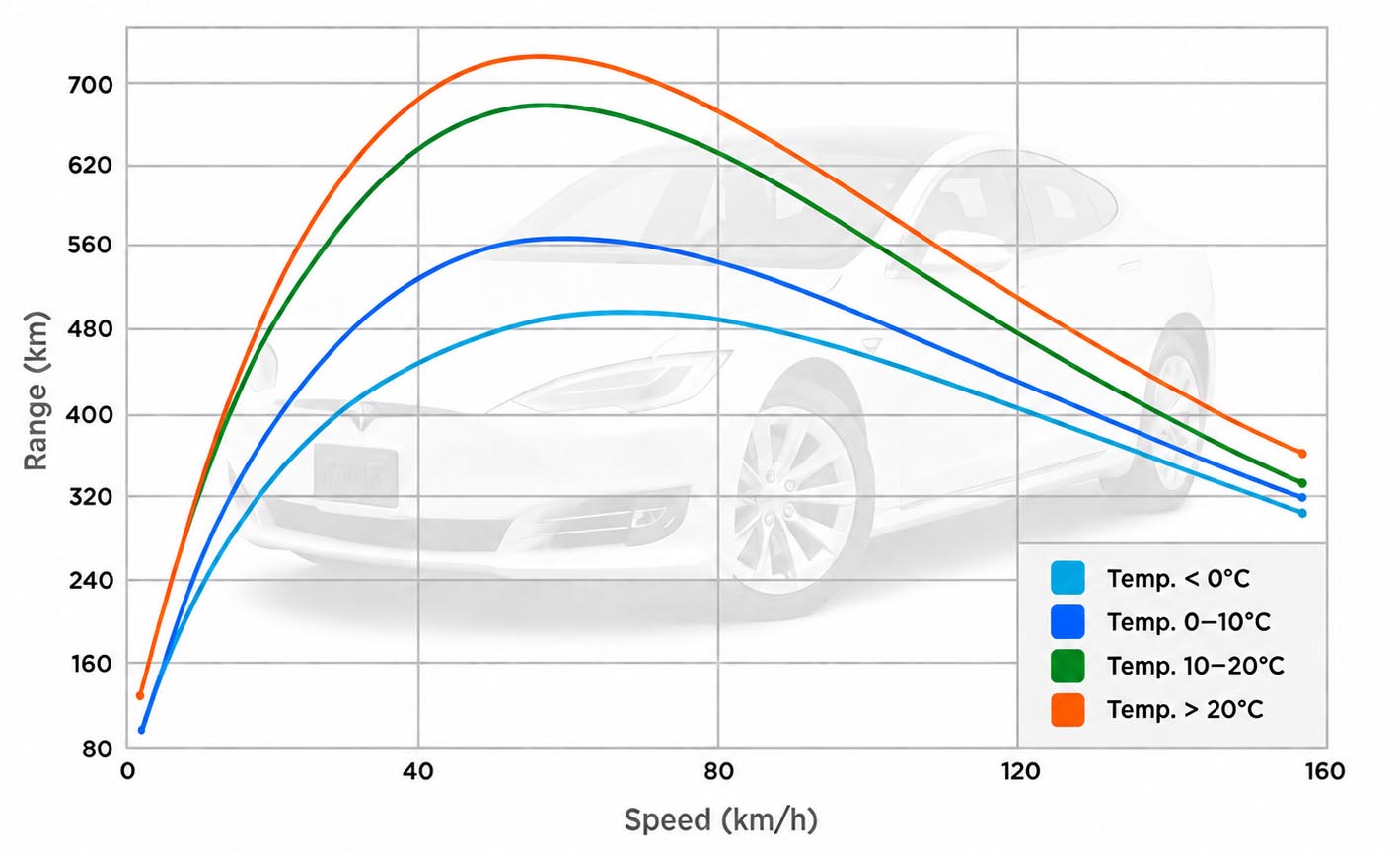 Relationship between Tesla Model S 100 range, speed, and temperature.
Source: A Better Routeplanner (ABRP); data from 805 Tesla vehicles.
- Battery management system operation. The BMS (Battery Management System) monitors the condition of the battery and limits the available state-of-charge range. This is necessary to protect the cells from overcharging and deep discharge.
- Differences in cell parameters. Over time, individual cells and modules may begin to differ in capacity, internal resistance, and state of charge. As a result, the weakest group may limit the performance of the entire battery.
- Natural aging. During operation, irreversible chemical changes occur inside lithium-ion cells. Gradually, they lose their ability to store and deliver the same amount of energy as before.
Therefore, the range indication on the instrument panel should not be used as a parameter for assessing battery condition. It is a calculated value that depends not only on the actual battery capacity but also on the vehicle's operating conditions. If the driving range has decreased noticeably, high-voltage battery diagnostics are required to determine the cause.
What is battery degradation?
Battery degradation is a gradual and irreversible change in its physical and chemical properties that reduces its ability to store and deliver energy and may also reduce the maximum power output of the battery.
During the operation of a lithium-ion cell, lithium ions move between the cathode and anode. During discharge, they move in one direction, and during charging — in the opposite direction. Ideally, this process can be repeated many times. However, in a real battery, some of the lithium and other materials gradually participate in side chemical reactions. Over time, this reduces the amount of lithium available to participate in the normal operation of the cell.
The most important processes associated with degradation of an electric vehicle battery are as follows:
1. SEI layer growth. A protective film called SEI (Solid Electrolyte Interphase) forms on the surface of the anode. It is necessary for normal battery operation, but it continues to grow over time and consumes some of the available lithium. The higher the temperature, the faster the processes that contribute to the growth of this layer generally occur. Therefore, overheating is one of the factors that accelerate battery aging.
2. Metallic lithium plating. Under certain conditions, lithium ions do not have enough time to properly intercalate into the anode material. Instead, some of the lithium is deposited on its surface as metallic lithium. The risk is particularly high when charging a cold battery at high current. Some of the deposited lithium may participate in further reactions and turn into so-called «dead lithium», which no longer contributes to energy storage.
3. Active material damage. During repeated charging and discharging, the materials of the electrodes change in volume. Under high loads and unfavorable conditions, this can lead to the formation of microcracks in particles of the active material. Through these cracks, the electrolyte gains access to new surfaces where additional side reactions occur. This accelerates further cell aging.
4. Changes in cathode structure. High temperatures and other unfavorable conditions can cause changes in the structure of the cathode material. As a result, some of the active material loses its ability to properly participate in the reversible transport of lithium.
All these processes gradually lead to two main consequences: available capacity decreases and the internal resistance of the cell increases. Increased internal resistance causes additional heating at high current levels. High temperature, in turn, accelerates many aging processes. Therefore, different degradation mechanisms can reinforce each other and gradually accelerate battery wear.
.jpg) Average annual rate of decline in available battery capacity under different DC charging patterns.
Average annual rate of decline in available battery capacity under different DC charging patterns.
Source: Geotab EV Battery Health Study, 2025–2026.
Can several cycles actually improve battery performance?
We can now return to the main question of the article. A full charge and discharge cycle cannot restore the physically lost capacity of a degraded lithium-ion cell. If irreversible chemical changes have occurred inside the cell, several cycles will not restore its original characteristics.
However, there are situations in which battery parameters can actually improve after several cycles.
The first is related to the battery management system (BMS). It continuously calculates the state of charge, available capacity, and other parameters based on voltage, current, and temperature measurements. Over time, these calculated values may require adjustment. After a full charge and discharge cycle, the BMS receives additional data and can refine its calculations. As a result, the owner may sometimes see an increase in the calculated capacity or estimated driving range. It is important to understand that in this case, the battery itself is not being restored; rather, the accuracy of its condition assessment is being improved.
The second situation can occur after a battery has been stored for a long period without being used. For example, a vehicle may be undergoing repairs after an accident, or a high-voltage battery may be stored separately from the vehicle for an extended period. After a prolonged period of inactivity, the distribution of lithium within the electrodes may become less uniform. Several controlled charge and discharge cycles may partially restore this balance. As a result, available capacity may increase slightly. However, this still does not mean that degraded cells have been restored. Rather, the battery begins to use more effectively the capacity that was already available.
Conclusion
Thus, several full charge and discharge cycles do not restore a physically degraded electric vehicle battery, but in some cases they can correct BMS calculations or improve the utilization of available capacity after a prolonged period of inactivity.
To determine the actual cause of reduced driving range and assess whether the battery can be restored, professional high-voltage battery diagnostics are required. For such tasks, MSG Equipment offers the MS801 tester, which enables diagnostics of lithium-ion modules in high-voltage batteries of modern electric vehicles and evaluation of their key parameters: capacity and internal resistance.